Overview
Preventing a neck hump is considerably easier than attempting to correct one that has already formed. However, postural changes remain possible at any stage if the underlying mechanics are addressed early and consistently. The aim of early training is to maintain mobility through the cervicothoracic junction, preserve muscular balance, and prevent structural adaptation.
Background
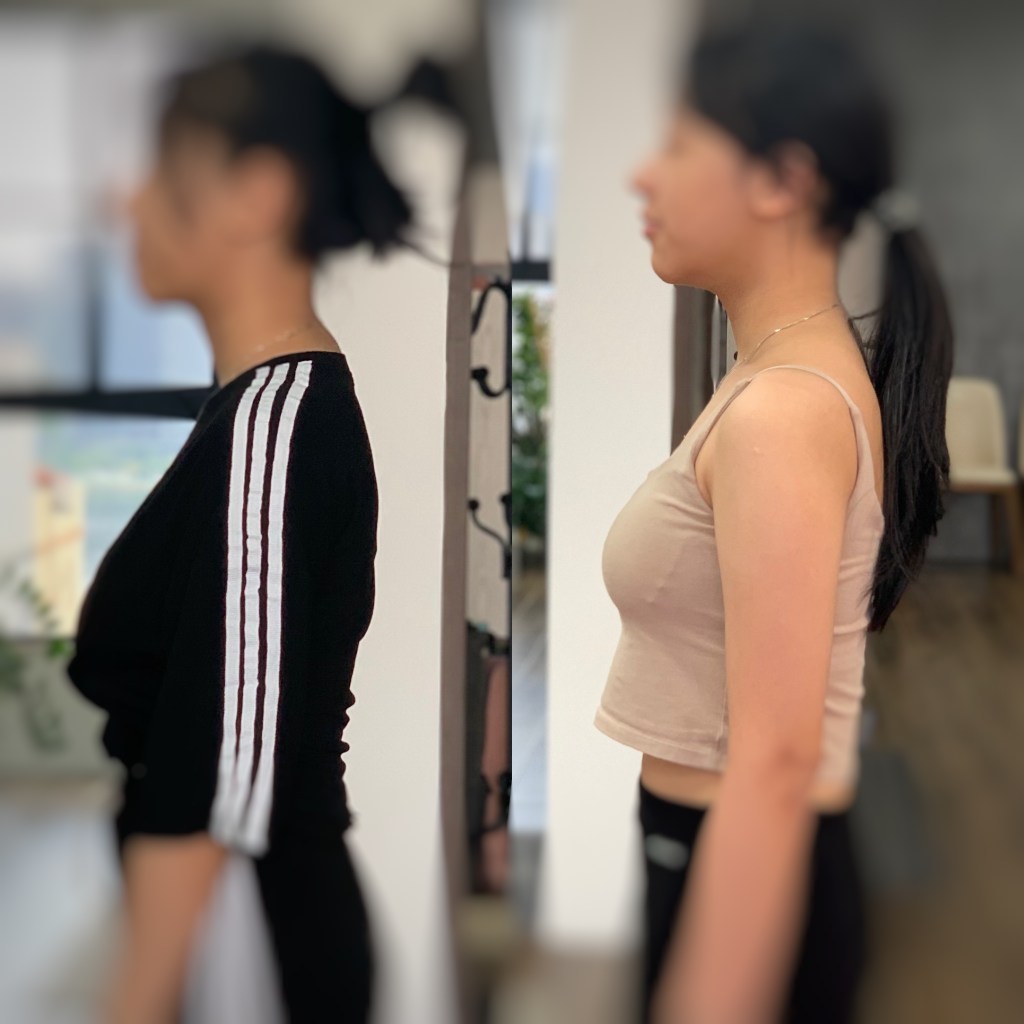
A fifteen-year-old girl and her mother attended class presenting with postural asymmetry. The daughter displayed forward head carriage and mild thoracic rounding without reported pain or stiffness. Her presentation suggested a functional postural deviation rather than structural change. The training program therefore emphasized prevention, alignment control, and neuromuscular conditioning.
Anatomical Foundation
The region most involved in early neck hump formation is the cervicothoracic junction (C7–T3). In forward head posture, the upper trapezius and levator scapulae remain chronically shortened, while the deep cervical flexors lose strength and endurance. The thoracic extensors particularly the longissimus thoracis and spinalis thoracis become inhibited, allowing progressive rounding of the upper thoracic curve. Shortening of the pectoralis minor and anterior deltoid contributes to scapular protraction and anterior translation of the shoulder girdle. Over time, the posterior soft tissue thickens due to continuous mechanical load and adaptive fascial change around C7–T1.
Training Approach
The training combined motor control exercises and postural retraining to restore normal alignment between the cervical and thoracic segments.
The focus included:
- Strengthening the deep neck flexors to stabilize the cervical curve
- Facilitating the lower trapezius and serratus anterior to improve scapular positioning
- Increasing thoracic extension through segmental mobility drills
- Stretching the pectoralis minor, levator scapulae, and suboccipital group to reduce anterior and superior tension
- Reinforcing correct alignment during standing and seated activities to improve habitual postural patterns
Outcome
After thirty days of consistent participation, the student demonstrated improved postural alignment and increased control of cervical and thoracic movement. The shoulder girdle repositioned closer to neutral, the upper back appeared more open, and head carriage normalized relative to the midline. She also showed enhanced strength and proprioceptive awareness during static and dynamic tasks.
Key Insight
Early training yields the most efficient results. Once structural adaptation occurs, improvement becomes slower but remains achievable through consistent, targeted work.
 Mulberry Whale